

“WHAT?” you say. “You haven’t even reviewed the Daevabad trilogy yet, and here you are, already jumping to the fourth and final book of the series?”
Well… yes? The Daevabad trilogy, starting with The City of Brass, then The Kingdom of Copper, and finally The Empire of Gold, is already well reviewed all over the internet, so I won’t bother reinventing the wheel. To be fair, I actually have done a review video on the trilogy as well, but since it is rather eye-damagingly cringe, I would kindly recommend @CronkTheBookGuy instead for those of you who want a review of the main trilogy. (Though if curiosity is getting the better of you, you can always DM me for that video). Cronk is the reviewer in the realms of fantasy and sci-fi, so rest assured to be whisked away to the magical city of Daevabad with the below video.
But today’s review, my review, is not about the trilogy but The River of Silver, the collection of stories before, during, and after the main trilogy. It’s certainly nowhere near as well-known as the three main books, so consider my abovementioned decision justified. S.A.Chakraborty has included some of the stories in certain editions of each book in the trilogy before, but she has kindly collected them in this newest book (instead of us nerds having to buy each edition and sucking up every morsel). We Daevabad fans only have one job to do: Digging in!
WARNING: SPOILERS FOR THE FIRST THREE BOOKS
Book review #8: The River of Silver by S.A.Chakraborty
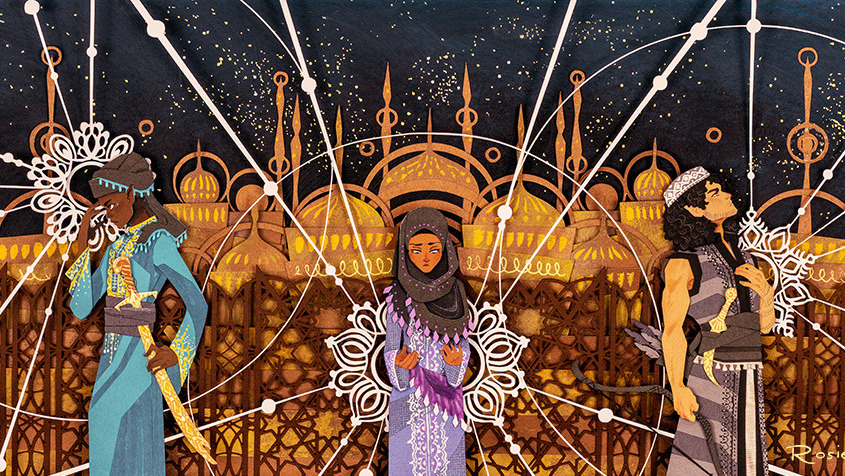
A not-so-spoiler-free synopsis:
All stories are ordered chronologically, starting from decades before the event of The City of Brass to a year and a half after the Empire of Gold. We have the stories of:
- Manizheh after giving birth to Jamshid
- Duriya’s budding relationship with Rustam
- Hatset before her marriage with Ghassan
- The scouts in an alternative prologue to The Kingdom of Copper
- Nahri early in her marriage with Mutandhir
- Ali’s adventure in Bir Nabat
- Ali with Nahri in the hospital’s garden (Yipee!!)
- Zaynab after The Kingdom of Copper
- Zaynab and Aqisa meeting Dara
- The syrupy sweet ending with Ali and Nahri
And yes, more stories about Jamshid and Mutandhir than I can count, interspersed between the above chapters.
Personal opinion:
Okay, I’m gonna be honest here and admit to skipping over to the Ali and Nahri chapter at first, which meant literally skipping the whole book. My bad, but who could blame my eagerness? But then again, the fact that all bloody conflicts had been (mostly) resolved made the chapter of the two seem a bit… fan-fictionish, if you know what I mean. Nonetheless, they still hold the spot of the best Fantasy couple in my heart, and the chapter also concludes Nahri’s arc of having the courage to build her own happiness.
After cheating by reading the last chapter, I did return to the beginning. I initially thought I wouldn’t enjoy this book as much as the main trilogy, for I already knew what happened inside out. But alas, I couldn’t be further from the mark, for once again, I was fully immersed into the magic of Daevabad – an undeniable testament to Chakraborty’s hypnotizing prose 🙂
Beside Nahri and Ali’s chapters, I also appreciated the insights into Mutandhir and Jamshid’s. If we’re being real here, their relationship is even more trying than that of the protagonists as it is enmeshed so deep in political intrigue and factionalism. I would argue the two men’s relationship is an excellent paragon for secret romantic relationships!
And I can’t omit… Manizheh herself. However much I disliked her in the main trilogy, Chakraborty succeeded in shining a light on this woman’s humane side. From Ghassan’s abuse to public humiliation before the whole court to estrangement from her own newborn, Manizheh, in my view, really shines as a nuanced character, an unfortunate case of a genius turned tyrant with the new chapter from her POV.
Lastly and most importantly, I love that the book acknowledges the struggle of building a new government. By this time, it is as much a well-used trope as the truth, from building a new kingdom in Mistborn to building a new America after the American Revolutionary War, that the warring part may seem nowhere as hard as keeping a stable government afterward. The River of Silver ends by acknowledging this difficulty for Daevabad while offering hope for a better and more peaceful future among the tribes – which is the pinnacle of realist perfection, if you ask me.
Oh, on that note, I’d love to announce that I’ll review The Well of Ascension next. It’s a very, very strange read on post-war rebuilding and governance, and not pleasantly so.


Leave a Reply