
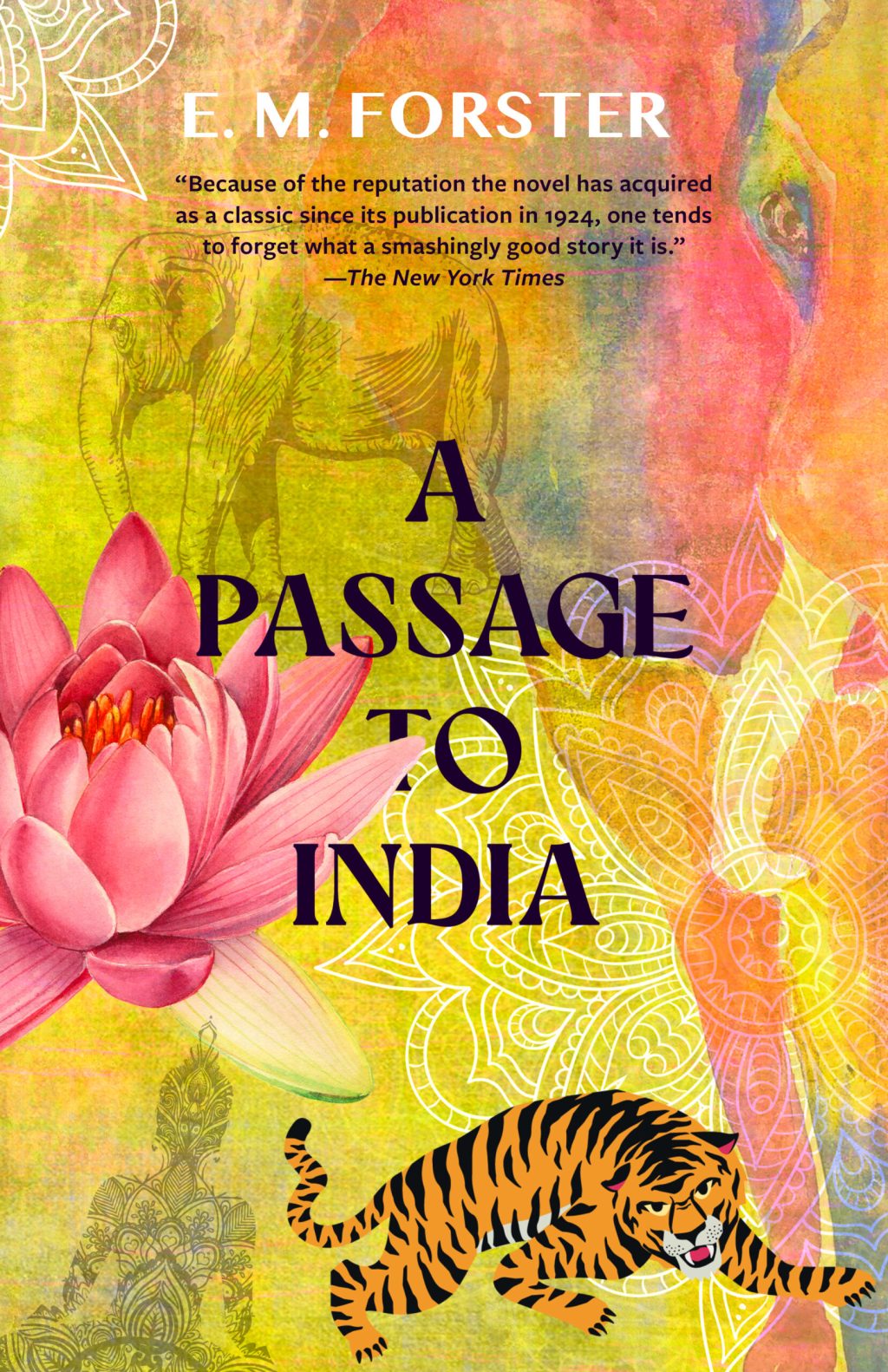
I must admit that I’m normally rather wary of reading novels centered on a non-Western culture but written by an “outsider” to that culture. While E. M. Forster did travel widely in India and even served as private secretary to the Maharaja of Dewas for a year, I never expected the degree of respect and depth he would devote to India in his last novel.
#BookReview: A Passage to India by E. M. Forster
A Spoiler-free Overview:
In the city of Chandrapore, under the rule of the British Raj, a Muslim doctor, Aziz, chances to meet an Englishwoman, Mrs. Moore, at a mosque. She has recently arrived in India with Ms. Adela Quested, whom she hopes her son Ronny Heaslop, the city magistrate, will marry. As Adela takes time to process her feelings for Heaslop, the two women grow closer to Dr. Aziz. When Dr. Aziz invites them to visit the famous Marabar Caves, an unforeseen incident ultimately triggers the eruption of prejudice and resentment between Indians and the British ruling class that has been building for far longer.
Personal Opinion:
+) Pro – Excellent Writing Packed with Insight: As with any Forster’s novels, the exquisite writing didn’t disappoint! It’s not heartachingly beautiful like Morrison’s or Kingsolver’s, but transcendental in the sense that every other passage contains reflections on relationships, human nature, and the fragility of the British Empire in India, among other themes.
+) Pro – Distinct Characters and Relationships: The characters, even the secondary ones beyond Dr. Aziz, Mrs. Moore, Adela, and Mr. Fielding, are distinguishable and possess their own quirks and eccentricities that reflect the two cultures as well as the racial prejudice at the time. By the end, the main characters developed convincingly. Perhaps the highlight of the novel must be the relationships, especially that between Dr. Aziz and Mr. Fielding. I can’t reveal too much or else I would spoil something, but their friendship evolves in a convincing rather than overly idealistic way considering the backdrop of racial tension under British Raj.
+) Pro – A Balanced, Sympathetic, and Respectful Story: As mentioned at the beginning, I was wary that an “outsider” to India may harbor inevitable biases. Well, Forster certainly did, but for the most part, I believe he was as impartial as an English writer in the 1920s could be and paid adequate tribute to both the East and West without vilifying or turning either into an idealized fantasy. For a novel written over a century ago, this is certainly a feat of literary integrity if you ask me!
-) Con – India-Specific Vocabulary and Dated terms: Because the novel was set in India a century ago, there are bound to be unfamiliar words (e.g. fez, punkah, landau) that are either specific to India or old-fashioned, or, unfortunately, both. Translation will certainly impede reading speed and possibly reduce reading enjoyment, but I believe it’s ultimately a worthwhile trade-off.
-) Con – A Slow Start: For lovers of action-packed stories, well, this might not be the ideal novel for you. Although the blurb clearly indicates that an incident would occur at the Marabar Caves with devastating consequences, the characters didn’t arrive there until chapter 13, almost halfway through the book. The first part preceding the arrival there especially dragged for me, and it required considerable grit on my part to finally arrive at the climax of the story.
Overall, although A Passage to India is by no means an easy read, neither in form nor content, it is ultimately a worthwhile one, thanks especially to Forster’s delicate and respectful treatment of India and its diverse peoples.
 THE AVID READER
Leave a comment