
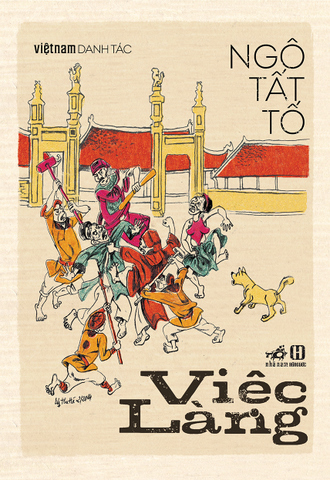
It’s all too common for students like me to read about the unbearable suffering of peasants before 1945. That said, the suffering is often talked about in general terms (say, village officials suppressed the poor peasants), and Village Affairs is a perfect book for those wanting to know more about the gritty details of life in feudal Vietnam.
#BookReview: Village Affairs by Ngô Tất Tố
A Spoiler-free Overview:
Village Affairs is a collection of sixteen satirical reportage essays written in the 1930s, exposing the corruption and injustices in rural Northern Vietnam through outdated and often outrageous customs.
In the first essay, the narrator, who worked as a journalist, paid a visit to an old friend who was on his deathbed. Although the old man was still alive, there was already a buffalo wrestling match and a lavish meal underway outside his house. By his deathbed, the journalist listened to the tales of backbreaking work the old man had shouldered all his life, and yet, he was still dirt-poor at this very moment. All because of village affairs, such as the buffalo wrestling match and the party already being prepared for his impending funeral. The powers that be exploited and invented village rules and traditions that repressed both the poor and the landed who lack connections. In his dying wish, the old man wanted the journalist to expose these cruelties, wanted “the intellectuals to finally cast their eyes toward a forgotten class behind the bamboo groves.”
The next fifteen essays were the journalist’s attempts to honor the late man’s wish, exposing the various anachronistic and superstitious customs. From selling entire fortunes to present the finest altar chickens to bribing village officials to officially “integrate” into a village, such practices show their true colors as the shackles that unrelentingly gripped peasants in feudal Vietnam under French colonial rule.
Personal Opinion:
+) Pro – Authenticity: The author himself was a journalist, travelling to the different villages as in the book to document the myriad oppressive rules and customs that village officials impose upon the people. Hence, I believe the veracity of the materials could hardly be doubted, and they offer insightful glimpses into life back then in rural Northern Vietnam.
+) Pro – Comprehensiveness and Conciseness: Spanning sixteen essays, each focusing on a central custom while also tackling relevant ones, the book certainly covers a significant portion of anachronistic traditions at the time. Though holistic, it’s equally succinct, for each essay (in my estimation) spans roughly three A4 pages.
+) Pro – Readability: Though written nearly a century ago, the language is accessible. In my Minh Long edition, there are in-depth footnotes for more dated terms (which are not many) and those explaining which parts were redacted by French censorship. Of course, I would’ve learned new words if it was written in a more “advanced” tongue, but after being left out of my depth by Robert Stone’s introduction to The Quiet American by Graham Greene, I’m inclined to value readability more from now on.
-) Con – Repetitiveness: Although each chapter shines a light on a different out-dated and outrageous custom, the fact that the book revolves around provincial villages that were in fact almost identical can make it repetitive quickly.
Overall, Village Affairs is still a worthwhile read for those who want to venture beyond textbook generalities into the actual wiles and capers of the village officials that so brutally and tragically characterized feudal Vietnam.
 THE AVID READER
Leave a comment