
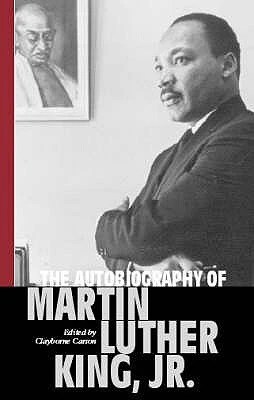
Amid a world marked by increasing geopolitical violence and tension, it may be tempting to dismiss Martin Luther King Jr.’s principle of nonviolent resistance as futile or overly idealistic. Yet a closer examination of this remarkable man’s life, the once-unimaginable successes his philosophy of nonviolence achieved in advancing civil rights, and its far-reaching influence within the United States and beyond points in a very different direction.
#BookReview: The Autobiography of Martin Luther King, edited by Clayborne Carson
Summary:
As meticulously explained in its preface, this book is not Dr. King’s autobiography in the strict sense, but rather a faithful approximation constructed by Clayborne Carson using Dr. King’s own writings and other primary source materials. It traces his life from a boyhood chafing against the constraints of segregation, through his university years studying theology, his pastorhood, and his civil rights activism, up to his assassination in 1968. The book also presents Dr. King’s lesser-discussed views on prominent figures of the era, including Malcolm X, John F. Kennedy, Lyndon B. Johnson, and Richard Nixon. Overall, it offers deep insights into the life of a remarkable man who continues to inspire civil rights advocates to this day.
Personal Opinion:
+) Pro – Exceptional autobiographical editing: Despite not being a bona fide autobiography written by Dr. King himself, the book succeeds in capturing his voice and thoughts with remarkable consistency. While I am by no means an expert on Dr. King’s writings, what I gleaned from iconic works such as the “I Have a Dream” speech and Letter from Birmingham Jail convinces me that the tone and style of this book align closely with what Dr. King might have produced had he written his own autobiography.
+) Pro – Relative comprehensiveness: As noted above, the book covers all stages of Dr. King’s life, from his childhood in Atlanta to his university years and marriage to Coretta Scott. A substantial portion is devoted to campaigns led or supported by the Southern Christian Leadership Conference (SCLC), including the Albany Movement, the Birmingham Campaign, the March on Washington, the Selma movement, and later the Chicago Campaign. For readers with only a fleeting acquaintance with what was arguably the most important social movement of the 1960s, this book will undoubtedly help fill that knowledge gap.
+) Pro – Authenticity: The book incorporates generous excerpts from Dr. King’s original writings, either italicized or presented in boxed sections. For example, in the chapter discussing his relationship with Coretta Scott, his letters to her are frequently quoted verbatim, offering authentic glimpses into his life as a husband. At other points, seminal speeches and writings, including his final speech, “I’ve Been to the Mountaintop,” delivered in Memphis, are quoted in full or in part. While it is obviously impossible to include all of his sermons and essays, the selections provided are sufficient to offer a solid overview of his intellectual and moral legacy.
-) Con – Why an autobiography to begin with – and shouldn’t it be longer?: Given that Dr. King didn’t actively participate in writing this book, why present it from his perspective? Although I do understand Carson’s intention to preserve Dr. King’s voice and to minimize external interpretation, I still believe that a more traditional, in-depth biography could offer greater insights into the man’s life. As it stands, the book numbers at just 366 pages – making it somewhat insufficient in capturing Dr. King’s short but profoundly inspiring 39 years.
That said, The Autobiography of Martin Luther King, Jr. remains an excellent starting point for general readers seeking to learn more about this extraordinary figure. For those truly interested in Dr. King and the period, the America in the King Years series is, by all accounts, the most comprehensive account of his life, spanning an impressive 3,000 pages! That number is admittedly intimidating, but this autobiography has certainly whetted my appetite for more.
 THE AVID READER
Leave a comment