
Household names like Michelle Obama, Jesse Owens, Toni Morrison, Oprah Winfrey. Music genres like jazz, rock, rhythm and blues, and hip-hop. The fact that the US opened its doors to non-White people from the 1960s onward.
At first, this might look like a collection of random facts. But not so much, for all of them owe their origins to a massive migration, one that stretched from 1915 to 1970, had from five to eight million participants, and fundamentally changed the United States in all respects.
Yes, you’ve guessed it right. The Great Migration.
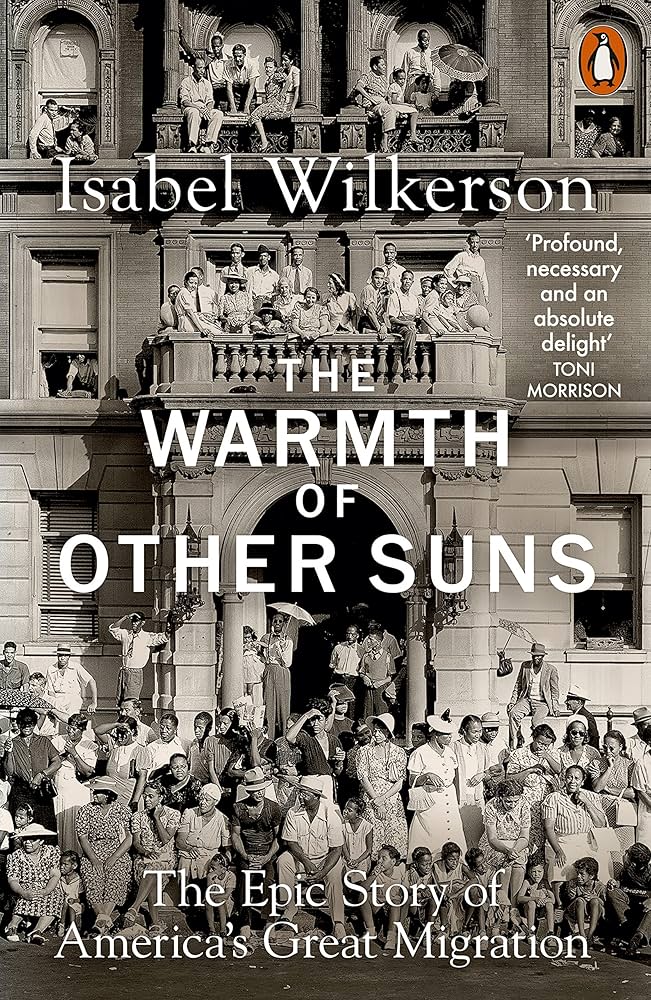
#BookReview: The Warmth of Other Suns by Isabel Wilkerson
A spoiler-free synopsis:
This book follows the lives of three individuals, each charting their own, very different course but all seeking a better, freer life for themselves and their families:
Ida Mae Brandon Gladney: A cotton picker in Mississippi, she left with her young family in 1937 after they heard about the brutal beating of her husband’s cousin by his landowner on a false accusation of theft. The family headed for Milwaukee, and later Chicago, a land where they hoped no white person could claim jurisdiction over their lives at any moment.
George Swanson Starling: Son of an orange picker in Eustis, Florida, George Starling was a stellar student, even reaching his sophomore year of college, before he was forced to stay home and pick oranges for financial reasons. At the orange groves, by taking advantage of the labor shortage caused by World War II, he encouraged other pickers to stand up and demand higher wages. Hearing word that he was about to be lynched by a white mob, he fled to New York City in 1945, away from the Old Country where he would never submit to self-degradation.
Robert Pershing Foster: A surgeon who served in the Korean War, Robert Foster stood up for his country and yet was denied practice in a local hospital in Monroe, Louisiana. Refusing to become a country doctor whose medical equipment filled up a single suitcase, in 1953 he set out on a perilous journey of over 2,000 miles – a stretch whose every motel would deny him accommodation – to reach the rumored “Paradise” – California.
Though all migrants seek a better life, these individuals and their largely distinct backgrounds represent the broad spectrum of participants in the Great Migration. Various anecdotes of other migrants along the way further bolster and diversify the narrative, ensuring a comprehensive understanding of this under-researched exodus. Will these émigrés find the Promised Land they dreamt of, or is that magical place also tainted with prejudice and abuse of its own kind?
Personal Opinion:
If you’ve been looking for a definitive guide to the Great Migration or America’s race history from 1915 to 1970, this is your go-to book. The Warmth of Other Suns provides background information, interspersed with the three main narratives, that give readers unfamiliar with the event like me a useful vantage point for what is to unfold. Also, I’m not kidding when I say “definitive,” for in researching this book, Isabel Wilkerson interviewed upwards of 1,200 people. Sure, do not judge anything by the stats alone, but if a book with this amount of research put into it isn’t worth reading, I don’t know what is.
Within the main narratives themselves, the author kindly provides little input but lets us truly feel with the characters. All events are recounted authentically – the jubilation and heartbreak, triumphs and despairs – we feel it all with Ida Mae, George Starling, and Robert Foster. My heart almost burst as I saw all three of them up against hatred and racism. Prejudice, though ostensibly tempered in the North, consistently reared its ugly head: Black Americans found themselves relegated to the lowest of jobs, having to sue to live in the very houses they bought with their own money, facing neighborhood-wide opposition – and sometimes death threats -when trying to integrate new neighborhoods, facing riots, the Northern manifestation of lynching, and so much more. All three characters lead amazing lives not because of their heroics but because they persevered in a system rigged against them till the end. Personally, I find Robert Foster an especially interesting character, who has more complexities than I’ve ever known in any fictional character. Such is the beauty of life, am I right?
As the timeline progresses, we see America open up to people of color. This wouldn’t have happened without the indelible impacts of the Great Migration and the millions of Black Americans who had the grit and determination to make the journey in the first place. For those who seek to understand American history, reading about this exodus is a must.
 THE AVID READER
Leave a comment