
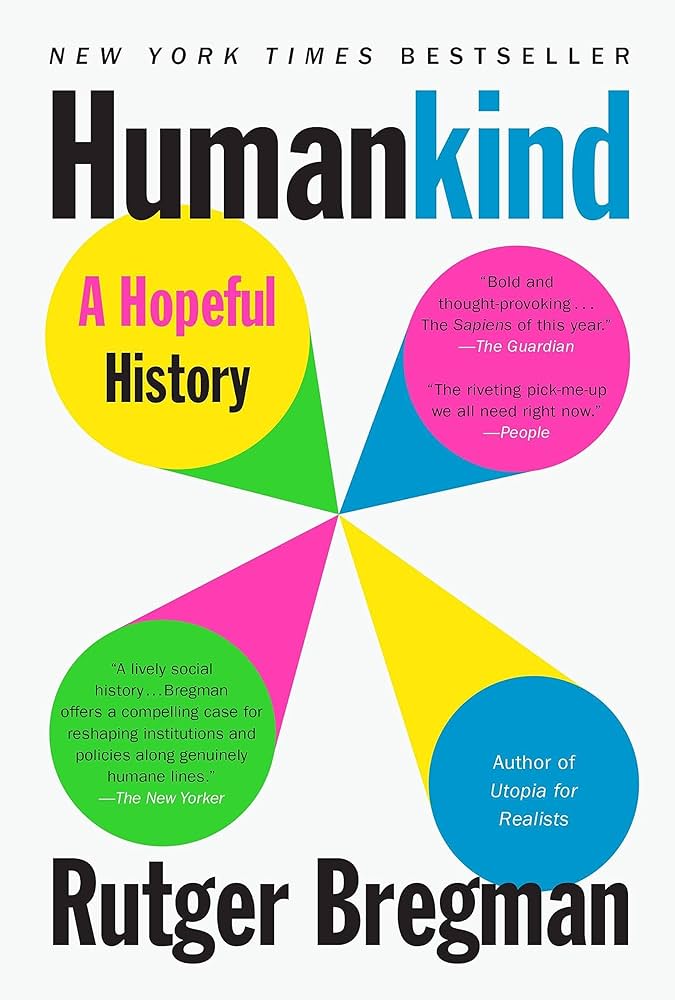
If you’re one of those (or the majority, if we’re being honest) who equate realism with cynicism, then brace yourself, for Rutger Bregman is hell-bent on proving that we humans are inherently decent!
#BookReview: Humankind: A Hopeful History by Rutger Bregman
Synopsis:
In Part 1, Bregman sets out to disprove the Hobbesian belief that humans are inherently selfish and that civilization merely acts as a fragile facade concealing our true nature. Instead, he argues that civilization itself has been the curse of our once-peaceful species, at least until very recently. In doing so, he supports the Rousseauian idea that humans have, from the very beginning, been inherently friendly.
In Part 2, the author discredits some of the most influential experiments and cases that have long fueled cynicism, from the infamous Stanford Prison Experiment to the murder of Catherine Genovese and the 38 witnesses. (He, by the way, also debunks Lord of the Flies in the introduction.)
In Part 3, Bregman zooms out once again to examine why humans commit atrocities, whether through blind empathy or corruptive power. The remainder of the book explores how we can apply this “new realism” to overhaul our mindsets and institutions, paving the way toward a more peaceable and realistically optimistic world.
Personal Opinion:
This book is commendable for its sheer depth of research alone. The author himself probably knows it, given that asserting humans are inherently kind is quite a bold stance in today’s divided world. So, while his arguments may initially seem far-fetched, every claim is backed by abundant evidence. That’s not to say I accept everything he writes. For instance, while I agree that both the Stanford Prison Experiment and Stanley Milgram’s shock-machine study are fundamentally flawed, I remain unconvinced by his counterarguments to the “Tragedy of the Commons.” Still, whether or not you agree with Bregman’s conclusions, his counterevidence makes for an excellent exercise in critical thinking, forcing us to reconsider what we once thought was gospel truth.
Another strong point is Bregman’s accessible, down-to-earth writing style. He always defines psychological jargon (and often pokes fun at it in the process.) His witty prose compels readers to keep turning pages in a topic that’s supposed to be boring while gaining a clear grasp of many seminal theories in the canon of psychology (many of which he attempts to debunk).
That said, I – and apparently many other Goodreads readers – can’t shake off the feeling that Bregman cherry-picks facts and examples to support his claims. He does so by citing specific cases, then referencing certain meta-analyses (Read: studies that analyze other studies) that suggest the original theory doesn’t hold up. But in the same vein, there’s also plenty of evidence supporting those very theories, which is precisely why they remain in textbooks in the first place. So, again, take this book as an exercise in critical thinking. After all, we don’t read books just to agree with the author, but to form our own opinions.
Ultimately, I believe human nature isn’t binary. We’re neither purely good nor purely bad but exist on a spectrum. Still, I have to give Bregman credit: I genuinely think most of humanity leans more toward the “good” side. Still feeling cynical? Just give this book a try!
 THE AVID READER
Leave a comment